
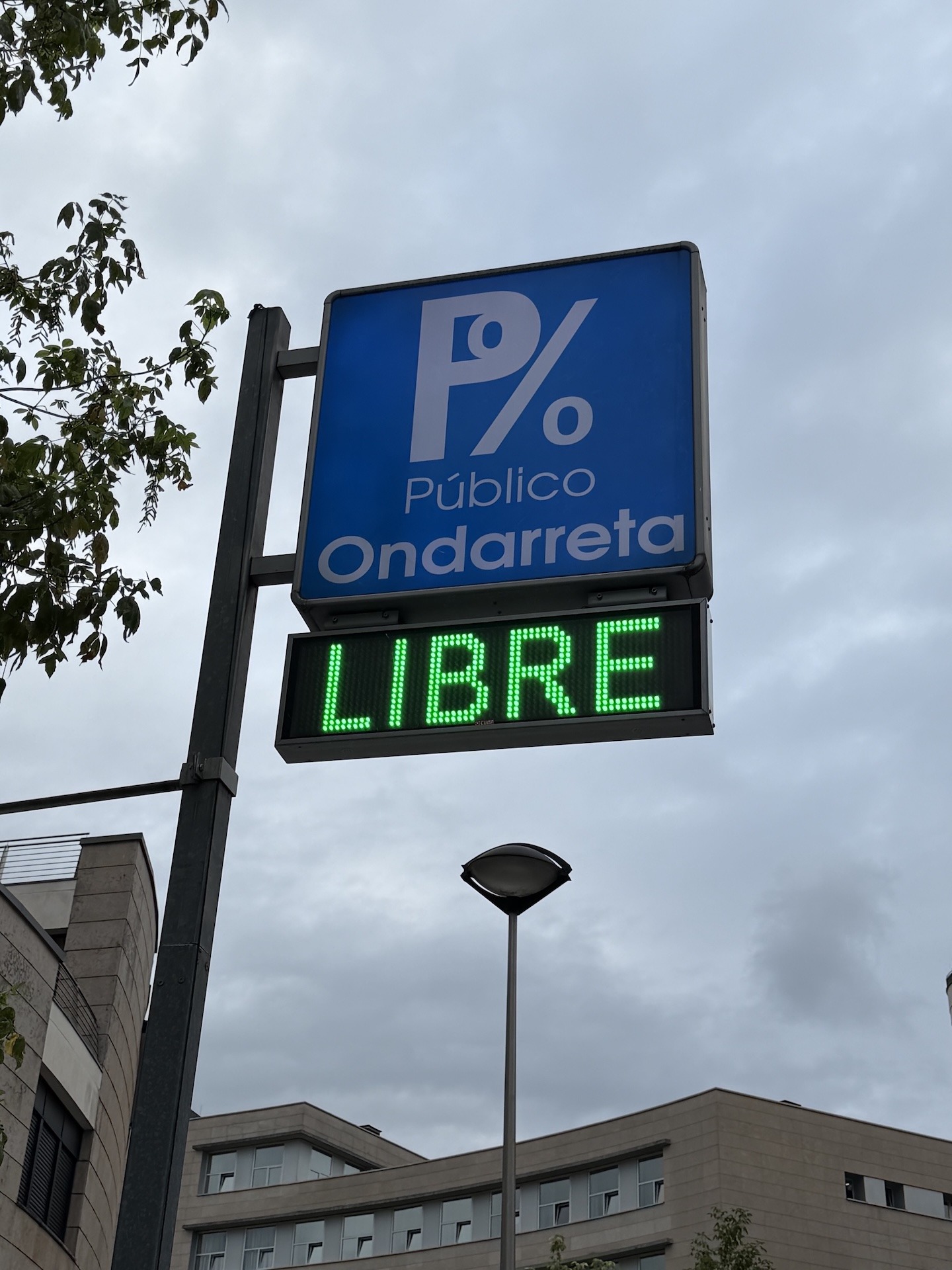
The most important thing first: San Sebastián is a city made for walking, and driving into the centre is rarely a good idea. Parking is expensive, scarce and governed by a low emission zone. If you’re coming by car anyway, this guide has everything you need: the OTA system of colour-coded street zones, the central car parks, the free park and ride sites on the edge of town – and the one rule that most often catches out cars with foreign number plates. Travelling by motorhome or bicycle? Scroll down for the official camper areas and the key cycling rules.
Quick answer on the go
My favourite: Parking Txofre in Gros (Calle Bermingham 27). It’s outside the low emission zone, so you don’t need to register. According to the operator, booking online gets you up to 12 hours for €16 and a full day from €21 – much cheaper than the car parks in the centre. The Kursaal and Zurriola beach are a few minutes away, the Old Town a good ten. Note: maximum height 1.90 m, no lift. Directions
Most central: Boulevard (Telpark), right next to the Old Town – convenient, but the most expensive at €31.60 to €37.65 a day, and inside the low emission zone. Directions
Cheapest: the free park and ride sites on the edge of town, such as Illunbe, then onwards by bus. Details below.
Low emission zone: covers the Parte Vieja, Centro, Área Romántica, Amara Viejo and San Roque, but not Gros or Antiguo. With foreign number plates, register online for free beforehand – otherwise you risk a €200 fine.
Prices according to the operators, as of October 2026. Rates may change.
Free spaces in the car parks – right now
Live figures from the city, updated every few minutes. Green = plenty of space, yellow = filling up, red = almost full.
…
Parking in San Sebastián at a glance
- Scope: low emission zone across the whole centre, five OTA tariff zones, around a dozen central car parks
- Best time: street parking is mostly free on Sundays and public holidays
- Budget: street parking priced by tariff zone, car parks considerably more expensive, park and ride free
- Who it’s for: anyone arriving by their own car, hire car or motorhome
- Low emission zone: foreign number plates need to be registered online in advance – no sticker on the car
- OTA hours: Monday to Friday roughly 9:00–13:30 and 15:30–20:00, different hours on Saturdays
- Payment: ticket machine or app – have your number plate and zone code ready
- Motorhomes: official areas at Berio (paid) and two at Illunbe (free), each for a maximum of 72 hours
- Cycling: around 65 km of cycle lanes, park at the bike racks
The ZBE low emission zone – and what foreign number plates really need
Since 2025, Donostia has had a low emission zone: the Zona de Bajas Emisiones, in Basque Isuri Gutxiko Eremua. It covers around 1.2 square kilometres – 122 hectares with roughly 22,468 residents – and so takes in much more than just the Old Town: besides the Parte Vieja, it includes the Ensanche or Área Romántica, the Centro, Amara Viejo and San Roque. To the north, the zone reaches the Paseo Nuevo and Monte Urgull; to the south, the Paseo de Errondo and Calle del Parque; to the west, the Paseo de Miraconcha and Calzada de Aldapeta; and to the east, the mouth of the Urumea. The through route between Amara and Gros via Paseo del Árbol de Gernika and Paseo de los Fueros is exempt. Exactly which streets are included, where the cameras are and which car parks are inside or outside the zone is shown on the city’s official map. Enforcement is entirely by number-plate cameras. A sticker behind the windscreen does nothing here – neither a Spanish one nor one from your home country.
Which brings us to the most important point for anyone arriving in their own car: vehicles with foreign number plates don’t need a Spanish environmental sticker, they need an online pre-registration. Through the city’s portal you register your number plate and vehicle registration document – the so-called declaración responsable – so the cameras recognise your car as authorised. The city explains the procedure on an English-language information page, and the online form is available in English too. In the first phase, running from 2025 to 2027, foreign petrol or diesel cars and vans first registered from 01/01/2006 may enter the zone, as may motorbikes and mopeds from 01/01/2004. Hybrid, gas and electric vehicles also have to go through the procedure, even though they are clean enough anyway – for them, the registration date doesn’t matter. Note that you won’t receive a confirmation: the city only gets in touch if information is missing. The authorisation is valid until the end of the first phase in 2027.
So a car from 2010 can enter without any problem – as long as it’s registered. The second phase starts in 2028, when vehicles with a B label will also be excluded. According to the city of Donostia, driving into the zone unregistered or without authorisation costs €200; for more than one offence within a year, the amount can rise by 30 per cent. The most honest advice remains: don’t drive in at all. The city itself recommends parking outside and continuing on foot, by bike or by bus. As of August 2026 – no liability for regulations; check donostia.eus before you travel.
Street parking: the OTA system (Zona Azul)
Almost all street space near the city centre is pay-and-display – the so-called OTA system, TAO in Basque. Contrary to what you’ll often read, the colour of the road markings doesn’t tell you who may park, but how much it costs and how long you may stay. Blue is present in all paid zones and is combined with the colour of the respective tariff level.
Understanding the colours
- Blue and orange: the most expensive level, right in the centre – roughly between Urbieta and Paseo Nuevo, around Buen Pastor, the Boulevard and the Avenida. Maximum stay usually 90 minutes. Calle Matía in Antiguo and the Paseo Ondarreta are also in this category.
- Blue: mainly in parts of Amara Nuevo and Antiguo. Usually 90 minutes as well; some sectors allow three to five hours.
- Green: the cheapest and most generous level, three to nine hours depending on the sector. Found in Amara Nuevo beyond Pío XII to Illunbe, in San Roque, in Sagués in Gros, in Igara, along the Riberas de Loyola, near Anoeta and in Antiguo.
- Red: a separate tariff level with a very short maximum stay, for quick errands.
- Special zone: recognisable by sand-coloured road markings, with its own rules.
In practice, for visitors this means: if you only need to pop in briefly, look for a central zone and allow 90 minutes. If you want to stay longer, deliberately drive a little further out to a green zone and walk the last few minutes – it’s cheaper and far more relaxed than running back to the car every hour and a half.
Hours and payment
In the central sectors, charges apply Monday to Friday roughly from 9:00 to 13:30 and from 15:30 to 20:00. Saturdays have different hours, which can extend into the evening depending on the sector. On Sundays and public holidays, street parking is mostly free. Hours and rates vary from sector to sector and partly by season – the binding information is on the signs and the ticket machine, not in any app.
Paying by app is more convenient than using the machine, because you can extend your parking time on the go and in some cases get unused time refunded. The city’s official app works just as well as Europe-wide providers. Always have your number plate and zone code ready – every app asks for them every time.
When things go wrong: fines and the vehicle pound
An OTA offence ends up under your windscreen wiper as an aviso de denuncia – and then speed matters. These notices can be cancelled within 24 hours directly at the ticket machine, or alternatively in the ElParking app. You then pay only a small amount, depending on the tariff zone: around €4 in the green zone, €5 in the blue, €7 in the red and €9 in the special zone (as of 09/08/2026). Miss that deadline and the full fine is sent to your home address, which runs well into double figures; for serious offences such as forged tickets or permits, the municipal bylaw allows up to €190. Be sure to keep the cancellation receipt. If your car is towed, it ends up in the municipal vehicle pound, the Ibilgailuen Udal Gordailua on Plaza Leire, Morlans Pasealekua 7. The pound is staffed around the clock and can be reached on +34 943 32 06 58; as a rule, you get the vehicle back straight away once you’ve paid the fee. A tip learned the hard way by many visitors: white markings in Donostia do not automatically mean free parking.
The central car parks
Around the Old Town, the Centro and La Concha there’s a ring of underground car parks, most of them open around the clock. They are both the most convenient and the most expensive option. Pay on the spot at the barrier and you pay the full rate; booking online in advance is usually noticeably cheaper. If your hotel offers its own parking space, that’s the most stress-free option anyway.

In high summer and on the big festival weekends, the central car parks are full from late morning onwards – that’s when a detour to the edge of town pays off twice over. In winter things calm down considerably, and you can still find a space at La Concha at lunchtime.
| Car park | Location | Open |
|---|---|---|
| Boulevard Telpark | Boulevard Zumardia 2 · Parte Vieja | 24 h |
| Okendo Telpark | Plaza de Okendo · Parte Vieja | 24 h |
| Paseo Nuevo | Monte Urgull · Parte Vieja | 7:00–21:00 |
| La Concha Telpark | Askatasunaren Hiribidea · Centro | 24 h |
| San Martín | Urbieta Kalea 9 · Centro | 24 h |
| Buen Pastor | San Bartolome Kalea 1 · Centro | 24 h |
| Plaza Easo Telpark | Easo Plaza 8 · Centro | 24 h |
| Garaje Norte | Zaragoza Plaza 2 · Centro | Mon–Sat 7:00–24:00, Sun 8:00–24:00 |
| Kursaal | Zurriola Hiribidea · Gros | 24 h |
| Txofre | Bermingham Kalea 27 · Gros | 24 h |
| Ondarreta | Julio Caro Baroja Plaza 1 · Ibaeta | 24 h |
Price-wise (as of August 2026), the central car parks charge around €2.55 to €3.65 for the first hour and roughly €31.60 to €37.65 for a full day. The most expensive are Boulevard, Okendo and La Concha, each at €3.65 for the first hour and €37.65 a day – in return, you’re right by the Old Town and the bay. It gets cheaper on the edge of the centre: Plaza Easo costs €2.55 for the first hour and €31.60 a day, and San Martín and Buen Pastor are also €31.60 a day; at the Kursaal you pay €3.10 for the first hour. The Telpark car parks Boulevard, Okendo, La Concha and Plaza Easo are staffed and under video surveillance around the clock.
Park and ride: the cheapest option
The most relaxed and cheapest way is to park on the edge of town and cover the last few minutes by bus or on foot. The city runs free park and ride sites for this, the aparcamientos disuasorios. The best known is Illunbe on Elisabete Maiztegi Kalea south of the stadium: 494 spaces, parking itself free, connected to the centre by Dbus lines 17 and 28. In summer 2026, an additional shuttle bus also ran to Plaza Centenario from 11 July to 31 August, every 30 minutes daily, leaving Illunbe from 11:00 to 22:30. Important: the car park is free, the bus is not – until 2023 the shuttle was free, but since 2024 the normal Dbus fare applies (€1.95 in cash, cheaper with a Mugi card, contactless bank card or QR ticket from the Dbus app). Also free is the Igara park and ride in the west: 180 spaces, connected by Dbus lines 25 and 33, but with an explicit maximum stay of 24 hours.
Don’t confuse it: the Anoeta Aparkalekua by the stadium looks like a park and ride, but it charges – albeit at moderate rates. And if you only need the car for day trips in the region, use the strategy the locals use: leave the car on the edge of town, get around the city on foot, and only move it on the days you’re actually heading out of Donostia.
Coming to San Sebastián by motorhome or camper van
Donostia is popular with campers – and is now cracking down hard on wild overnight stays as a result. The city’s principle is roughly “parking is not camping”: a motorhome may park at the roadside like any other vehicle, but not with the awning out, chairs or a camping table – and free overnight camping within the city limits is not tolerated. You won’t get into the centre with a camper anyway, because of the low emission zone and the low car park entrances. The relaxed solution is the official motorhome areas on the edge of town, all outside the ZBE.
There are three municipal areas, all with a maximum stay of 72 hours:
| Area | Location | Spaces | Price | Services |
|---|---|---|---|---|
| Berio | Paseo Berio 12 | approx. 44 | approx. €11 high / €5.50 low season | Fresh water |
| Illunbe (with services) | Miramon Pasealekua | 17 | free | Fresh and grey water, rubbish |
| Illunbe (without services) | Miramón-Zorroaga | 27 | free | none |
The same applies everywhere: these are parking areas, not campsites. Putting out the awning, setting up tables and chairs or staying longer than allowed will get you into trouble. If you want proper camping comfort with showers and electric hook-ups, or want to stay longer, head for the Igueldo campsite up on Monte Igueldo.
And the low emission zone applies to motorhomes too: vehicles with foreign number plates need the same online pre-registration as cars (see the section on the low emission zone above). The motorhome areas themselves are outside the zone; from Illunbe you can easily get to the centre by bus or on foot.
Cycling in San Sebastián
If any city is made for cycling, it’s Donostia: flat, compact and with a network of around 65 kilometres of cycle lanes, known as bidegorris. For most journeys around town, a bike is quicker and more relaxed than any car – and the whole parking question solves itself.

Where you can ride
You ride on the bidegorris, in signposted shared traffic zones and, where there are no cycle lanes, on the road. The pavement is off-limits – pavements and promenades are reserved for pedestrians. Children under 16 must wear a helmet; on interurban roads, helmets have been compulsory for everyone since October 2026.
Where to park your bike
The best place to leave your bike is at the bike racks found all over the city. Make sure you don’t block pavements or entrances. For valuable bikes, there’s a supervised bike park at the Euskotren station in Amara.
Bike sharing: Dbizi rarely suits visitors
According to the operator, the city’s bike-sharing system Dbizi, with its mechanical bikes and e-bikes, is not intended for tourist use. You can register with a passport, but there’s only an annual or a 30-day subscription, no day or weekly passes, and rides may last no more than two hours. For a city break, it’s hardly worth it. You’re better off with one of the many private bike hire shops, many with e-bikes and guided tours – easy to rent by the hour or the day.
🚗 Traffic in Gipuzkoa
Loading traffic information …
Which option suits you?
- Several days in the city: park and ride or hotel parking – leave the car where it is.
- One day out and about in the centre: book a car park in advance.
- Several hours, on a budget: green OTA zone on the edge of town, then walk.
- Short stop: central zone via app, allow 90 minutes.
- Sunday or public holiday: street parking is usually free – read the signs anyway.
🗣️ My Impressions
Honestly: the best parking in San Sebastián is no parking at all. The city is compact, flat and wonderful to explore on foot – a car in the centre is little more than dead weight. When I stay for several days, I leave the car on the edge of town or book a hotel with parking and don’t touch it again until I leave.
What annoyed me most while researching: there are half-truths going around about the low emission zone that unsettle foreign drivers for no reason. Nobody needs a Spanish sticker. What you need is ten minutes at your computer before you leave – and then the matter is settled.
Practical tips
Before you travel: register your number plate online for the low emission zone. This only works in advance, not spontaneously at the zone boundary.
Signs: always read the sign at your parking space, not the colour of the space next to it. Sectors can change within the same street.
Events: during matches and concerts around the stadium, areas around Anoeta and Illunbe may be closed. Watch out for notices.
Valuables: don’t leave anything visible in the car at ground-level car parks on the edge of town – as in any coastal city.
More recommendations in and around San Sebastián
Bilbao Airport to San Sebastián bus – next departures, live.
More on getting around and getting out (articles in German):
Getting to San Sebastián – plane, train, coach or car: all routes compared.
El Topo – the train to Hendaye makes the car unnecessary for half the coast.
Cycling in San Sebastián – cycle lanes, bike hire and tours into the surrounding area.
Where to stay in San Sebastián – neighbourhoods compared, including the question of hotel parking.
Day trips from San Sebastián – the 10 destinations where the car really pays off.
Frequently asked questions about parking in San Sebastián
Do I need a Spanish environmental sticker for the low emission zone?
No. Vehicles with foreign number plates register their plate and vehicle registration document with the city online in advance. Enforcement is by number-plate camera; a sticker behind the windscreen has no effect whatsoever.
Which cars may enter Donostia’s low emission zone?
In the first phase from 2025 to 2027, foreign petrol or diesel cars and vans first registered from 01/01/2006 may enter, as may motorbikes and mopeds from 01/01/2004. Hybrid, gas and electric cars must also register, but for them the registration date doesn’t matter. From 2028, vehicles with a B label will also be excluded.
What do the colours of the OTA zones mean?
They stand for the tariff level and maximum parking time, not for user groups. Blue combined with orange is the most expensive level in the centre, usually with 90 minutes; green is the cheapest, with three to nine hours on the edge of town.
When is street parking free?
Mostly on Sundays and public holidays. On weekdays, charges apply in the central sectors roughly from 9:00 to 13:30 and from 15:30 to 20:00, with different hours on Saturdays. The signs on site are binding.
Where is the cheapest place to park in San Sebastián?
At the free park and ride sites on the edge of town, above all Illunbe and Igara; the car parks are free, the bus into the centre costs the normal Dbus fare. If you want to park close to the city, Parking Txofre in Gros is the cheapest: according to the operator, up to 12 hours for €16 when booked online, and it’s outside the low emission zone. If you’re staying several hours, a green OTA zone also saves money.
Can I stay overnight in a motorhome in San Sebastián?
Yes, but only at the official areas: Berio (paid) and two areas at Illunbe (free), each for a maximum of 72 hours. Free overnight camping within the city limits is not tolerated – the rule is “parking is not camping”. For longer stays with full facilities, the Igueldo campsite is the right choice.
Where can I park my bike in San Sebastián?
Ideally at the bike racks found all over the city, without blocking pavements or entrances. For valuable bikes, there’s a supervised bike park at the Euskotren station in Amara.

About the author
Christian is a wine merchant and food blogger. On Gozatu! he writes about good food and drink in Donostia-San Sebastián and the Basque Country – with passion and soul, always first-hand. More about Christian →
Leave a Reply