
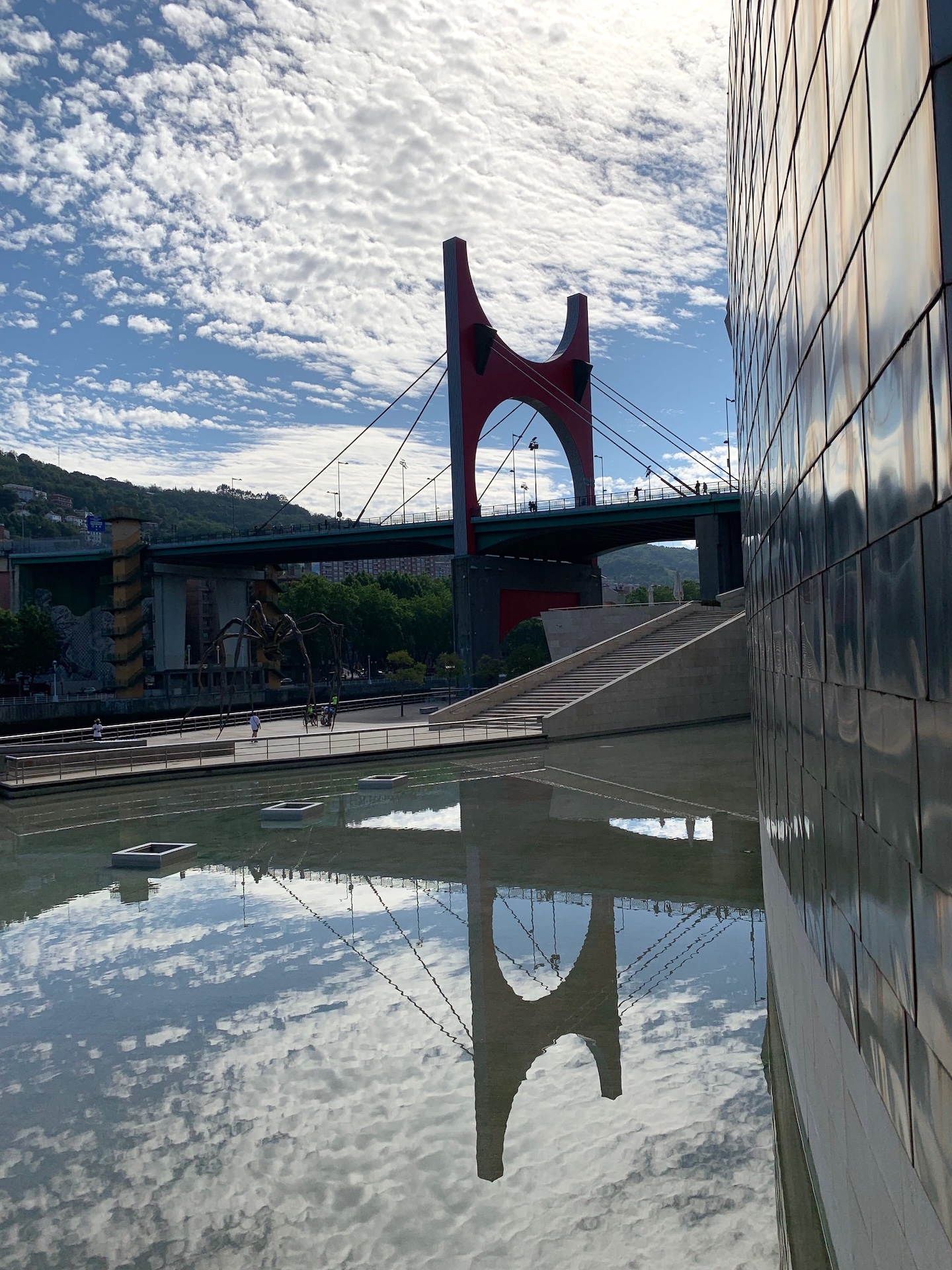
In a nutshell: In 1997 Frank Gehry’s museum on the Ría turned an industrial city into a destination – the “Bilbao effect” is named after it. 33,000 titanium panels, 19 galleries, Richard Serra’s walk-through steel spirals and, outside, a twelve-metre dog made of flowers. Admission €18, Tuesday to Sunday, daily in summer. If you only want to see the sculptures, you pay nothing at all.
Last updated: 12 September 2026 · by Christian Fenske
At a glance
- Name: Guggenheim Museum Bilbao, Frank Gehry, opened 1997
- Location: Abandoibarra on the Ría, Bilbao – around 100 km from Donostia
- Admission: €18, reduced €9, free for under-18s – outdoor sculptures free of charge
- Opening hours: Tue–Sun 10:00–19:00, closed on Mondays; mid-June to mid-September daily until 20:00
- Time needed: 2–3 hours for a first visit, plus 30–45 minutes for the sculptures outside
- Best time: November to February is noticeably quieter; in summer, early in the morning or towards evening
- Accessible: yes – lifts, accessible toilets, wheelchairs to borrow, tactile models for blind visitors
- With children: suitable – free for under-18s, and the outdoor sculptures work even without going inside
- Getting there: “Guggenheim” tram stop right outside, Metro Moyua; from Donostia by bus in around 1 hour 15 minutes
- My tip: The best bits cost nothing – Puppy, Maman and the fog sculpture stand in public space, around the clock

Gehry’s building: 33,000 titanium panels
In 1991 Frank Gehry won the competition against Arata Isozaki and Coop Himmelb(l)au. Work began in 1993, and by 1997 the building was finished. It was designed with CATIA, software from the aerospace industry – there would have been no other way to calculate the curves.
The skin is made of around 33,000 titanium panels, each about 0.4 millimetres thick, together weighing some 60 tonnes. They are so thin that they move slightly in the wind and look different with every change of light: silvery in the rain, almost golden when the sun is low. Add to that beige limestone from Huéscar and coated glass. Inside, three levels wrap around an atrium some 50 metres high, which Gehry himself calls “The Flower”.
Of the 19 galleries, ten are rectangular and clad in limestone, nine are free-form and clad in titanium. The largest, Gallery 104, measures just under 130 by 30 metres – without a single column.
You often hear that the building represents a fish or a ship. That interpretation does not come from Gehry himself. All that is documented is that the fish motif has occupied him since the eighties: “If you want to go back, you can go back 300 million years before humans, to the fish.” About the site, he said he was first offered a different plot – he turned it down, pointed to the riverbank and said: “There.”
The Bilbao effect
Bilbao was a city of steel and shipyards whose industry collapsed in the eighties. The idea that a single museum can turn such a city around has been an urban planning strategy ever since – and it bears this city’s name. In the first three years almost four million visitors came; within that time the economic impact had already exceeded the construction costs of around one hundred million euros.
The effect lasts. In 2025 the museum counted 1,305,003 visitors – an all-time record. 69 per cent came from abroad, nine per cent from Germany. The museum is around 78 per cent self-financed and, according to its 2025 annual report, sustained more than 14,000 jobs in the Basque Country.
The story also includes a day that almost destroyed everything. On 13 October 1997, five days before the opening, an ETA unit disguised as gardeners tried to plant explosives in flower tubs near the museum. The target was the opening ceremony with King Juan Carlos I. Ertzaintza officer José María Aguirre checked the suspicious van, was shot dead and in doing so prevented the attack. The often-told version that the bombs were hidden inside Puppy is not true.
What you can always see inside
The misconception most visitors arrive with: the Guggenheim is not a museum with a fixed display you can tick off. By far the largest part changes. Only a handful of works can be reliably planned for – but they are among the strongest.
Richard Serra, “The Matter of Time”. Eight sculptures in weathering (Corten) steel, created between 1994 and 2005, permanently in Gallery 104. You don’t look at them, you walk into them: through double ellipses, tilted spirals and corridors whose walls lean over you. You reliably lose your bearings – which is exactly the point. If you see only one thing in the museum, make it this.
Then there is Jenny Holzer’s “Installation for Bilbao” from 1997, with nine LED columns in Gallery 101, Yves Klein’s “Fire Fountain” and site-specific works by Eduardo Chillida, Louise Bourgeois, Anish Kapoor and Daniel Buren in the atrium and the outdoor areas. The museum’s own collection is shown in changing presentations – check what is on before you go.

The sculptures outside – free
The best thing about the Guggenheim costs no admission. All the outdoor sculptures stand in public space and are accessible around the clock.
Puppy by Jeff Koons has guarded the main entrance since 1997: 12.4 metres tall, weighing over 60 tonnes, planted with around 38,000 flowers. Twice a year, usually in May and October, the planting is changed – nine days’ work for twenty gardeners, with Koons himself designing the colour pattern. In spring begonias, busy Lizzies and petunias bloom, in winter pansies and primroses. The dog was originally installed in 1992 at Arolsen Castle in Hesse, Germany.
Maman by Louise Bourgeois stands on the bridge side: a spider around nine metres tall made of bronze, marble and stainless steel, with a sac full of marble eggs hanging beneath its body. Tall Tree & The Eye by Anish Kapoor on the river side consists of 73 mirrored steel spheres stacked around three axes – each one reflects the museum differently. Then there is a second Koons: Tulips, a bouquet of balloon flowers in high-gloss polished steel, a good five metres wide. The official artwork page at times lists it as not on display – you will only know whether it is there once you arrive.

And then the work hardly anyone knows: Fujiko Nakaya’s fog sculpture in the pool along the river façade. Fog rises from a thousand nozzles and swallows the lower half of the building. It runs every hour on the hour for eight minutes, until 22:00 in summer and 20:00 in winter – so long after the museum has closed. The abbreviation “F.O.G.” in the title stands for Frank Owen Gehry.

When it’s busy – and when it isn’t
With 1.3 million visitors a year, it is a fair question. The figures are clear: in August 2025, 194,954 people visited the museum, and over the whole summer from June to August 478,315 – a good third of the annual total in three months. On the record day, 13 August 2025, 8,472 people crowded into the building. By comparison, the average for January to May was around 88,000, less than half the August figure.
In winter it is noticeably quieter, and not just in the museum. Bilbao Airport counted only 365,944 passengers in January 2025, against 681,409 in May – a drop of 46 per cent. Hotel overnight stays in the Basque Country in January were around 44 per cent of the August figure, and even stays are shorter: 1.85 nights in January against 2.09 in August.
The weather is less of an obstacle than you might think. In winter Bilbao is mild and wet, not cold: 9 to 12 degrees on average, and frost and snow are practically a non-issue. It does rain, though – with around 147 millimetres, November is the wettest month of the year. For a museum that is no argument against going – quite the opposite.
There is one risk, however, and it concerns getting there. At both runway ends Bilbao Airport only has a Category I instrument landing system – in thick fog planes cannot land there, while airports such as Madrid keep operating. Flights are then usually diverted to Santander or Vitoria. In Loiu, though, fog is above all an autumn phenomenon: September and October bring an average of 3.0 and 2.5 foggy days, January only 1.2. The spectacular disruptions in the winter half of the year are caused instead by southerly storms – on 9 October 2024, Storm “Kirk” led to 42 flights being cancelled and 18 diverted.
The bottom line: if you want peace and quiet, come between November and February and build some slack into your journey. If you come in summer, go early or towards evening – and take advantage of the fact that from mid-June to mid-September the museum is open on Mondays too. Incidentally, the museum itself stresses that seasonality is increasingly blurring; the monthly figures still show the difference clearly.
Planning your visit: tickets, prices, times
Admission is €18, or €9 reduced for students aged 18 to 26, people aged 65 and over and visitors with disabilities. Under-18s go free; children under twelve must be accompanied. When exhibitions are being changed and galleries are closed, the reduced rate applies. The audio guide is included in the price but runs via a QR code on your own smartphone – bring headphones.
There is no general free day, whatever you may read online. What is documented is a different rule: on the last day of every temporary exhibition, admission is half price between 16:00 and 19:00. If you are flexible, that saves you nine euros.
You should buy tickets through the official shop – the museum explicitly warns against ticket fraud on third-party sites. There are no refunds. If you visit more than twice a year, membership is worth it at €40, or €70 for families.
As for how long you need, the museum itself gives two figures: around 90 minutes for the collection tour, five hours for a full day. For a first visit, two to three hours plus the time outside is realistic.
Three rules that matter at the security check: bags in the galleries may measure no more than 35 by 35 centimetres, and rucksacks and umbrellas must go to the cloakroom. Photography without flash is allowed, tripods and selfie sticks are banned. And if you need the cloakroom, arrive a quarter of an hour early.
Guided tours in German are possible but not part of the standard programme: they run as private tours at €100 per guide and must be requested by email at least two weeks in advance. Regular public tours are only offered in Spanish, Basque, English and French.
Getting there
The easiest way is by tram: the Euskotran stop is called “Guggenheim” and is right outside the building. By Metro, the right station is Moyua, exit “Ercilla-Guggenheim”, from where it is a five- to ten-minute walk. Many guidebooks name Abando instead – Metro and mainline trains do stop there, but it is considerably further to the museum. By bus, lines 1, 10, 13, 18 and A7, among others, stop at “Museo”.
From Donostia-San Sebastián it is around 100 kilometres, about 1 hour 15 minutes by bus – Bilbao is one of the destinations in our overview of day trips from San Sebastián. The museum has no car park of its own; the recommended options are the underground car parks at Plaza Pío Baroja and Plaza Euskadi.
You can eat in the building at two levels: Josean Alija’s Nerua (in German) is the starred address, and the Bistró in the same building is the more relaxed and cheaper option. Both belong to the museum – and the fact that two serious kitchens were planned in alongside the art comes as no surprise in the Basque Country. If you want to combine the museum with the rest of the city, you will find the way through the Casco Viejo, the Ensanche and Artxanda in the Bilbao guide.
🗣️ My impression on the ground
The Guggenheim is not only a landmark of the renaissance of an entire city and an entire region, it also stands for modernity and for art in all its facets – it rightly counts among the most spectacular museums in the world. The building alone is worth the visit. And when you take in the social life all around it, you only then realise what tremendous self-confidence this building has given an entire city.
That they created not one but two innovative and genuinely good restaurants along with it, the Nerua and the Bistró, to suit every taste and budget – for the Basques, of course, that almost goes without saying.
📍 Guggenheim Museum Bilbao, Avenida Abandoibarra 2, 48009 Bilbao, Bizkaia, Spain · Tel.: +34 944 35 90 00 | guggenheim-bilbao.eus
🕐 Opening hours & admission
| Tuesday – Sunday | 10:00 – 19:00 |
| Monday | closed, except in summer |
| 15 June – 13 September | daily 10:00 – 20:00 |
| Last admission | 30 minutes before closing |
| Closed | 25 December and 1 January |
| Adults | €18 |
| Reduced | €9, students 18–26, 65 and over, visitors with disabilities |
| Under 18 | free |
| Fog sculpture | every hour on the hour, 8 minutes, free |
⚠️ Prices and times as of August 2026. On the last day of a temporary exhibition, admission is half price between 16:00 and 19:00. Latest information at guggenheim-bilbao.eus.
🗺️ Location & directions
On the Ría in the Abandoibarra district, “Guggenheim” tram stop, “Moyua” Metro. Open route in Google Maps
Frequently asked questions about the Guggenheim Bilbao
How much does the Guggenheim Bilbao cost?
Adults pay €18; the reduced rate is €9 for students aged 18 to 26, visitors aged 65 and over and people with disabilities. Admission is free for under-18s. The audio guide is included. Prices as of August 2026.
Is there a free admission day?
No, there is no general free day. The only documented discount: on the last day of every temporary exhibition, admission is half price between 16:00 and 19:00. The outdoor sculptures – Puppy, Maman, Tall Tree & The Eye and the fog sculpture – are, however, always free to visit.
What are the Guggenheim Bilbao opening hours?
Tuesday to Sunday from 10:00 to 19:00, closed on Mondays. From mid-June to mid-September the museum is open daily and until 20:00. It is only closed on 25 December and 1 January. Last admission is 30 minutes before closing.
How long do you need at the Guggenheim Museum Bilbao?
The museum itself suggests around 90 minutes for the collection tour and five hours for a full day. For a first visit, two to three hours is realistic, plus time for the sculptures outside.
Which Metro station is closest?
Moyua, exit “Ercilla-Guggenheim”, from where it is a five- to ten-minute walk. Many guidebooks name Abando – Metro and mainline trains do stop there, but the walk to the museum is considerably longer. The tram stops right by the museum at the “Guggenheim” stop.
Is the Guggenheim accessible?
Yes. All lifts are wheelchair-accessible, there are accessible toilets on every floor, and wheelchairs can be borrowed on site. For blind visitors there are tactile models of the building and the sculptures as well as a descriptive audio guide, plus tours with sign language interpreters and induction loops. Reduced admission is €9, and a necessary companion goes free.
When is the Guggenheim busiest?
In summer. In August 2025 there were 194,954 visitors, and from June to August 478,315 – a good third of the annual total in three months. On 13 August 2025 alone, 8,472 people came in a single day. It is much quieter between November and February: Bilbao Airport counted around 46 per cent fewer passengers in January 2025 than in May.
Can you buy tickets on the day?
Yes. The museum ticket desk sells tickets from 10:00 to 19:00 and closes half an hour before the museum. On busy summer days you will have to queue – the official online shop is quicker and safer. Prices depend on the current exhibition: during exhibition changeovers and when galleries are closed, the reduced rate applies.
You might also like
Bilbao: the Casco Viejo old town, the Ría and the rebirth of a city
Nerua: starred cuisine at the Guggenheim (in German)
Day trips from San Sebastián: the 10 best destinations
San Telmo Museum: the oldest museum in the Basque Country (in German)
San Juan de Gaztelugatxe: rocky island and 241 steps
Total solar eclipse over Bilbao 2026 – Vega’s first-hand account (in German)

About the author
Christian is a wine merchant and food blogger. On Gozatu! he writes about good food and drink in Donostia-San Sebastián and the Basque Country – with passion and soul, always first-hand on the ground. More about Christian →
Leave a Reply