
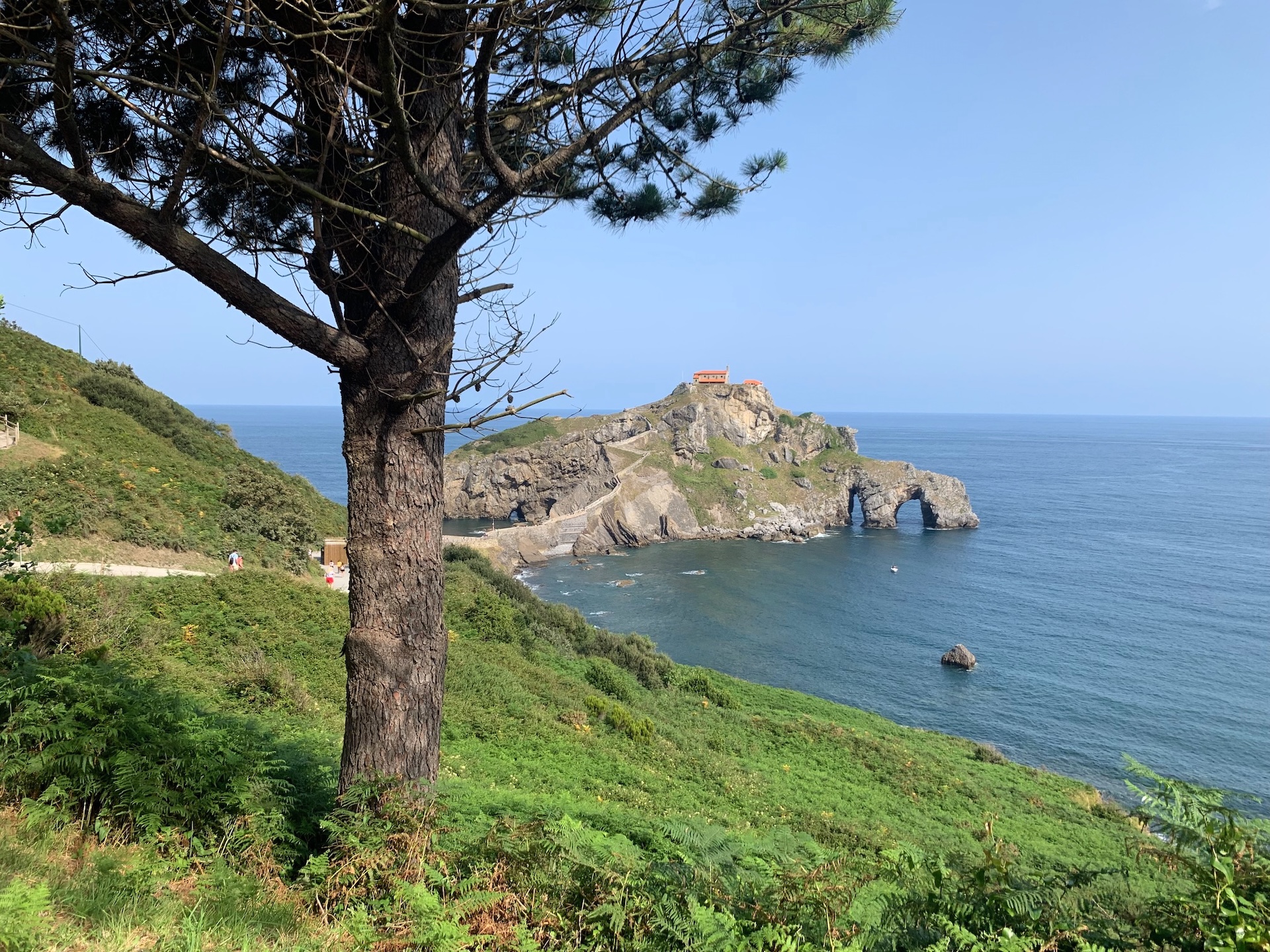
In a nutshell: San Juan de Gaztelugatxe is a rocky island off the coast of Bizkaia, connected to the mainland by an arched stone bridge. At the top, 80 metres above the sea, stands a hermitage – reached by 241 steps. The site has been documented since 1053, has been a protected biotope since 1998 and has been known around the world since 2017 as Dragonstone from Game of Thrones. In high season you need a free timed-entry ticket.
Last updated: 30 August 2026 · by Christian Fenske
At a glance
- Name: San Juan de Gaztelugatxe (in Basque: Gaztelugatxeko Doniene) – rocky island with a hermitage, protected biotope
- Location: BI-3101 between Bakio and Bermeo, Bizkaia – around 120 km from Donostia
- Admission: free; in high season a timed-entry ticket, also free, is compulsory via tiketa.eus
- Access: controlled within the daily time window until 7 pm, earlier in winter; closed during storms and wave warnings
- Time needed: 2 to 2.5 hours from the car park, including breaks and photo stops
- Best time: as early as possible; in high summer avoid the hours between 2 pm and 4 pm, as there is no shade at the top
- Accessibility: no – 241 uneven steps, and the path to the bridge has gradients of up to 35 per cent in places
- With children: challenging – 241 steps, the way back is uphill, and sturdy footwear is a must
- Getting there: just under two hours by car from Donostia, with only around 250 parking spaces; by Bizkaibus to the “Gaztelubegi” stop
- My tip: If you come before the daily time window starts or after it ends, you don’t need a ticket – and you’ll have the rock almost to yourself
What Gaztelugatxe is – and why everyone wants to go
The name says almost everything: gaztelu means castle, aitz means rock. The castle rock. A second reading interprets the ending as “difficult, inaccessible” – the impregnable castle. Both fit what you see in front of you: a rocky outcrop around a hundred million years old, rising out of the Bay of Biscay (Cantabrian Sea) and connected to the mainland by a narrow, double-arched stone bridge. If you want to get across, you have to walk. There is no other way.
At the top stands a simple hermitage dedicated to John the Baptist. It’s no grand building, just a whitewashed box that has withstood storms, plunderers and a fire over the centuries. It is precisely this combination – wild rock, slender bridge, tiny chapel – that makes the pictures everyone knows of Gaztelugatxe.
The rock and the neighbouring island of Aketxe have been protected as a Biotopo Protegido since 1998, 158 hectares in total. Aketxe is home to the only breeding colony of storm petrels in the Basque Country. That’s why rules apply here that don’t apply elsewhere on the coast: drones are restricted, dogs must be kept on a lead, and access is regulated.
The climb: 241 steps and two ways to get there
Two routes lead to the bridge, and which one you choose decides how strenuous your day will be.
Urizarreta is the main access route, by the information point: around 1,200 metres, with gradients of up to 35 per cent in places and some stepped sections. Short and sharp – downhill on the way there, uphill on the way back. At around 2,600 metres, Ermu is more than twice as long, but considerably gentler at about 15 per cent, and it follows a tarmacked, car-free road without steps. Both take 30 to 40 minutes each way – Urizarreta is the shorter but steeper route, Ermu the longer and more even one.
And then come the 241 steps. They are uneven, split into five sections, and wind their way up the rock in tight bends. If you count them, by the way, you’ll get to 242 on the way down – halfway up, one step is offset by around 45 centimetres and feels like two when you’re descending.
Allow 2 to 2.5 hours for the complete visit from the car park, including breaks and photo stops. Sturdy footwear is not a recommendation but a must – the stone gets slippery when it’s wet or there is sea spray. The site is not step-free: via Ermu you can get as far as the bridge with a pushchair or wheelchair, but the climb to the chapel is always by steps.

The ticket: free, but often compulsory
The visit itself costs nothing. But because the crowds grew bigger every year, the Diputación Foral de Bizkaia (the provincial council) has made access subject to a timed-entry ticket – purely a way of managing numbers, not an admission fee. You book online at tiketa.eus/gaztelugatxe, with a maximum of ten tickets per booking.
The ticket is not compulsory all year round, only at busy times: during Holy Week, daily from around mid-June to mid- or late September, plus at weekends and on public holidays in spring and autumn and on some bridge days (working days between a public holiday and a weekend). The Diputación sets the exact dates anew each year. Check the calendar on tiketa.eus before you set off; the dates circulating on travel websites contradict one another.
Two things that make all the difference: checks are only carried out within a daily time window that starts in the morning and ends at 7 pm, earlier in winter. If you come before or after that, you can cross without a ticket even on controlled days – and that’s also the quietest time. The exact start time changes with the season and is kept up to date on tiketa.eus; factor that in before you rely on it. And if you have a reservation, be on time: after about a quarter of an hour, your slot expires. You can cancel up to two hours before your slot.
On certain days of the year access is further restricted because of local pilgrimages, including 24 June, 31 July and 29 August. And during storms, heavy seas or wave warnings the path is closed completely – this happens regularly in winter and is not a formality but a matter of safety.
Getting there and parking
From Donostia-San Sebastián it’s around 120 kilometres, which takes just under two hours: the AP-8 to Bilbao, then the BI-631 towards Mungia and Bakio, and finally the BI-3101, the coast road between Bakio and Bermeo. From Bilbao it’s much closer – about 35 kilometres and around 50 minutes. As a half-day trip, Gaztelugatxe works better from Bilbao than from Donostia; if you’re coming from San Sebastián, allow more time and fill the day with other stops along the Bizkaia coast.
There are three car parks at the access point, with only around 250 spaces between them. Urizarreta, with about 25 free spaces, is the closest to the main access route. Eneperi, by the restaurant of the same name, is the largest, privately run and charges a fee. Lurgorri is free, lies on the Ermu access route and means about 15 minutes’ extra walking. All three are already within the municipality of Bakio – which is why sat navs often list Gaztelugatxe under Bakio’s postcode 48130, while the rock itself belongs to Bermeo. Between 10 am and 4 pm they fill up quickly in season, and the ticket doesn’t reserve you a parking space. If you want to play it safe, park in Bakio and walk.
Without a car, you can get there by Bizkaibus. The stop at the access point is called Gaztelubegi. In summer there are more frequent and in some cases direct services from Bilbao; outside the season you usually have to change in Bakio, and services are infrequent. Because the line numbers change with the season, it’s worth calling Bizkaibus information on +34 946 125 555 or checking the current timetable before you travel.
The best time to visit
Early. As early as you can. At weekends and in the summer months it gets noticeably busier from late morning, and on a narrow staircase you feel that straight away. For a quiet visit, the official Basque tourist office recommends spring or autumn anyway – advice that makes perfect sense once you’ve seen the August figures. How much the crowds now shape entire towns is a subject in its own right in the Basque Country, which we’ve looked at more closely in our piece on overtourism in San Sebastián (in German).
In high summer, avoid the hours between 2 pm and 4 pm – there is no shade on the rock. For photography, sunrise and sunset are the best times; from the Urizarreta and Ermu viewpoints you get the silhouette of chapel, steps and bridge in the evening. And it’s worth checking the tides: on a rising tide, the surf crashes far more spectacularly against the bridge.
History: from 1053 to the fire of 1978
Archaeological finds point to a structure on the rock as early as the 9th century. The first documentary record of the site dates from 1053, when Íñigo López donated it as “Sancti Johannis de Castiello” to the monastery of San Juan de la Peña. In the 12th century it became a convent. People like to say that the Templars were based here – there is no evidence for it.
After that, things get turbulent. In 1334 the rock served as a military stronghold in the conflict between Juan Núñez de Lara, Lord of Bizkaia, and King Alfonso XI of Castile. In 1593 Francis Drake plundered the site, and a year later Huguenots from La Rochelle raided it and killed the hermit. In 1886 it was extensively remodelled. On 10 November 1978 the church was gutted by fire; the reconstruction was completed on 25 June 1980.
To this day, the site lives on above all as a place of pilgrimage. On 24 June the people of Bermeo make their way up, on 31 July the procession from Arrieta arrives, and on 29 August the one from Bakio. Inside the chapel hang votive offerings, including model ships and maritime paintings – thanks from sailors who made it back. If you want to delve deeper into this world, we’ve written a separate instalment on whaling, world trade and Basque seafaring (in German).
Two customs persist stubbornly. The first: ring the bell three times, which is said to drive away evil spirits and grant a wish. Whether that’s currently possible depends on bird protection – at times the rope has been removed so as not to disturb the nesting birds. The second: the “footprint of the Baptist” in the rock, which you’re supposed to step into. According to legend, anyone who does so will be spared calluses for a year.

Dragonstone: Gaztelugatxe in Game of Thrones
For the seventh season of Game of Thrones, Gaztelugatxe became Dragonstone – the ancestral seat of House Targaryen. Filming took place here over three days, from 20 to 22 October 2016; the rock can be seen, among other scenes, in the one where Tyrion leads Jon Snow up the steps. The castle was created digitally; the rock and the winding steps are real. Since the series aired in summer 2017, the crowds have been on a different scale, and the compulsory ticket is partly a result of that.
It’s not the only filming location in the Basque Country: Itzurun beach in Zumaia became the beach of Dragonstone from 24 to 29 October 2016 – this is where Daenerys lands and later meets Jon Snow. Filming had taken place a few days earlier at Playa de Muriola in Barrika, where Tyrion and Ser Davos come ashore outside King’s Landing. Link the filming locations together and you have a route that, almost incidentally, takes in the most beautiful stretches of coast between Gipuzkoa and Bizkaia.
While you’re here: Bakio to the west and the fishing port of Bermeo to the east are each just a few minutes away and turn the detour into a full day out. You’ll find more destinations in this area in our overview of the best day trips from San Sebastián and in the guide to Bilbao (in German).
🗣️ My impressions on the ground
My visit was a long time ago, and I was a good deal younger then – yet one thing above all has stayed with me: how steep and strenuous the climb is. You can see the chapel above you the whole time, and it seems to get closer only very slowly. Back then there was no talk of compulsory tickets; you simply walked across.
At the top, the view more than made up for the effort. That rugged coast, the open Bay of Biscay, the wind – it’s one of those moments that make a path like this worth taking on. If you’re not sure whether the climb is worth it: it is.
📍 San Juan de Gaztelugatxe, BI-3101 between Bakio and Bermeo, 48370 Bermeo, Bizkaia, Spain | tiketa.eus/gaztelugatxe
🕐 Opening hours & access
| Site | accessible all year round, with a timed-entry ticket during controlled periods |
| Controlled hours | start in the morning, depending on the season; end at 7 pm, in winter at 5 pm |
| Ticket required | Holy Week, daily in high summer, otherwise weekends, public holidays and bridge days |
| Ticket price | free |
| Inside the hermitage | only on pilgrimage days for Mass |
⚠️ During storms, heavy seas and wave warnings, access is closed completely. The Diputación Foral de Bizkaia sets the exact ticket periods anew each year – check before you set off at tiketa.eus.
🗺️ Location & getting there
On the BI-3101 between Bakio and Bermeo, around 120 km west of Donostia-San Sebastián. Open route in Google Maps
Frequently asked questions about San Juan de Gaztelugatxe
Do you need a ticket for Gaztelugatxe?
At busy times, yes: during Holy Week, daily in high summer, and at weekends, on public holidays and on bridge days. The ticket is free and is booked online at tiketa.eus, with a maximum of ten per booking. Outside these periods and outside the controlled daily time window, no ticket is needed.
How many steps are there at San Juan de Gaztelugatxe?
241 steps lead from the bridge up to the hermitage, which sits 80 metres above the sea. They are uneven and split into five sections. On the way down, people often count one step more because of an offset halfway up.
How long does a visit take?
Allow 2 to 2.5 hours from the car park. The walk there takes 30 to 40 minutes depending on the route, plus the climb up the steps, time at the top and the way back – the strenuous part, because then it’s uphill.
How do you get from San Sebastián to Gaztelugatxe?
By car it’s around 120 kilometres and just under two hours via the AP-8 to Bilbao and then on the BI-631 and BI-3101. Without a car, travel to Bilbao first and continue from there by Bizkaibus; the stop at the access point is called Gaztelubegi. The lines change with the season.
Was Gaztelugatxe a Game of Thrones filming location?
Yes. In the seventh season the rock stands in for Dragonstone, the ancestral seat of House Targaryen; filming took place here from 20 to 22 October 2016. The castle was added digitally; the rock and steps are real. Other filming locations in the Basque Country are Itzurun beach in Zumaia, where Daenerys lands, and Playa de Muriola in Barrika.
You might also be interested in
Zumaia: flysch, geopark and a dragon fortress on the Atlantic
Day trips from San Sebastián: the 10 best destinations in the Basque Country
Bilbao: Guggenheim, Casco Viejo and the rebirth of a city (in German)
Getaria: the village that changed the world (in German)
Overtourism in San Sebastián: dos, don’ts & how to travel responsibly (in German)

About the author
Christian is a wine merchant and food blogger. On Gozatu! he writes about good food and drink in Donostia-San Sebastián and the Basque Country – with passion and soul, always first-hand on the ground. More about Christian →
Leave a Reply