
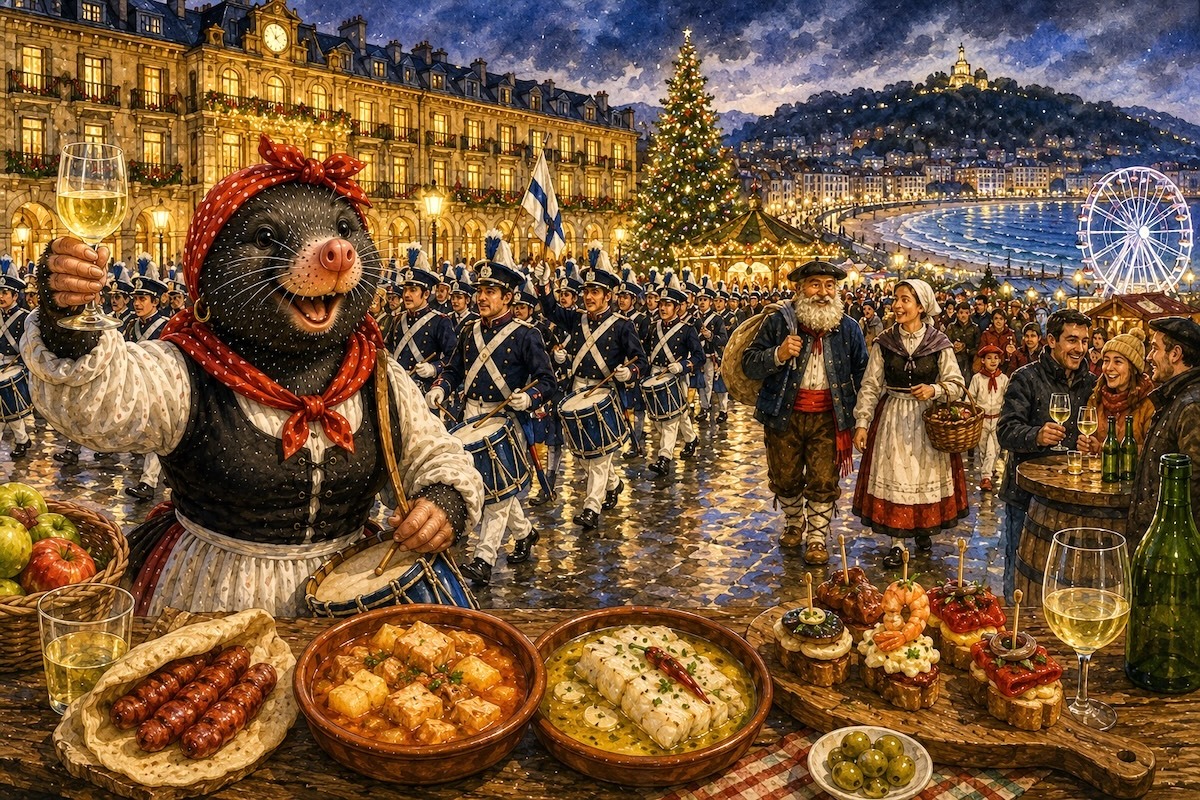
San Sebastián is beautiful in summer – in winter it is honest. No queues at the pintxo counters of the Parte Vieja, no battle for the last table; instead, locals dropping into their regular bar after work. Add a Christmas market on the Urumea, a drumming festival on 20 January that keeps the whole city awake for 24 hours, and, from January, the cider season in the sagardotegiak out in the countryside. If you want to see the city as it really is, come between December and February: the San Sebastián travel guide covers the basics, this post gives you the winter plan – and for trips out of town, see the overview of day trips from San Sebastián (in German).
San Sebastián in winter at a glance
- How long: 3 to 4 days for the city, 5 days with trips into the surrounding area
- Best time: December to February – 20 January is the most intense day of the year
- Budget: considerably cheaper than in summer; the only exception is the nights around 20 January
- Who it’s for: repeat visitors, food lovers and anyone who wants to experience Donostia without the crowds
- Highlights: Tamborrada (20 January), Feria de Santo Tomás (21 December), Gabonetako Azoka, txotx season
- Weather: mild and damp, in my experience usually 8 to 14 °C, practically never any snow
- Getting there: Bilbao Airport plus bus, trains from France and Spain; if you drive, the low-emission zone applies in the centre
The weather: an honest assessment
It rains in the Basque Country. That’s not a warning, it’s a promise. If you travel to Donostia in winter expecting a week of sunshine, you’ll be disappointed. If you pack a waterproof jacket and take it in your stride, you’ll have one of the most beautiful cities in Europe largely to yourself.
Temperatures are mild. On my winter visits the thermometer has almost always been between 8 and 14 °C. Snow in the city itself is so rare that the Donostiarras talk about it as if it were a natural wonder. And the rain? It has a certain charm when you watch it from inside a pintxo bar with a glass of txakoli in your hand.

The overview shows how the three winter months differ – each has its own character and its own festivals.
| Month | Highlights | Character |
|---|---|---|
| December | Feria de Santo Tomás (21st), Gabonetako Azoka, Olentzero (24th) | Christmas atmosphere, hardly any tourists |
| January | Tamborrada (20th), start of the txotx season | the most intense month of the year |
| February | Caldereros, Iñudeak eta Artzaiak (in 2027 already on 30/31 January), Santa Águeda, Carnival | steeped in tradition and exuberant |
Christmas 2026 in San Sebastián: all the dates
The key dates of the 2026/27 festive season at a glance (as of November 2026). For what’s on before that, see San Sebastián in November (in German):
- From Saturday 7 November: Ferris wheel in Alderdi Eder park by La Concha, €6 per ride, €3 on Mondays
- Friday 4 December, from 18:30: drone show and switching-on of the Christmas lights
- 4 December to 6 January: Christmas market (Gabonetako Azoka)
- Saturday 19 December: Gilda Eguna – the Gilda (in German) for €1 all day in more than 100 bars across Gipuzkoa
- Monday 21 December: Feria de Santo Tomás
- Thursday 24 December: Olentzero and Mari Domingi parade
- Tuesday 5 January 2027 (evening): Cabalgata de los Reyes Magos, the Three Kings parade
21 December: Feria de Santo Tomás – the city becomes a farmers’ market
Before winter really gets going, 21 December offers a foretaste of the best of Basque culture: the Feria de Santo Tomás. On this day San Sebastián turns into one huge country market. The undisputed star is chistorra.
The idea is simple: the farmers from the surrounding area, the baserritarras, traditionally came into town on this day to pay their annual rent and, while they were at it, to sell their best produce. Today many locals still wear traditional farmers’ dress, a pig is traditionally put on display in the Plaza de la Constitución, and the whole city smells of chistorra on the grill.
The classic trio of the day: talo (corn flatbread), chistorra and cider. Plus cheese, honey, vegetables, txakoli and everything a good Basque caserío has to offer. Spend 21 December in Donostia and you’ll understand more about Basque culture in a single afternoon than from many a guidebook. If you’re still hungry afterwards, the Parte Vieja (in German) has the densest concentration of bars in the city.
December to 6 January: Gabonetako Azoka – the Christmas market
In 2026/27 the Gabonetako Azoka runs from 4 December to 6 January (usually 11:00–14:00 and 16:30–20:00, until 19:00 on 24 and 31 December and on 5 January, free entry) and is spread over two locations: the Paseo del Urumea and Plaza Ramón Labayen, both within sight of the Hotel María Cristina. Wooden huts, crafts, local producers, music.

The atmosphere is reminiscent of Vienna or Munich, but with more sea air and no mulled wine. Instead there’s txakoli, local liqueurs and Basque crafts. If you’re looking for gifts you won’t find in every souvenir shop, you’re more likely to strike lucky here than on the Boulevard.
What also defines the season is the lighting: arches of light and decorated façades stretch from the centre into the residential neighbourhoods, and the City Hall and the Palacio Miramar are specially illuminated. An evening stroll from the Boulevard across the Zurriola bridge to Gros (in German) and back costs nothing and is one of the loveliest things to do all season.

The City Hall by Alderdi Eder belongs on the route too – in winter it regularly serves as the backdrop for light projections and the city’s big events.

A fixture of the season is the 32-metre Ferris wheel with 24 semi-enclosed cabins in Alderdi Eder park right by La Concha. In 2026/27 it turns from Saturday 7 November; a ride costs €6, or €3 on Mondays. The view from the top over the bay lit up at night is one of those moments that needs no words.

24 December: Olentzero and Mari Domingi
While the rest of the world waits for Father Christmas, the Basque Country has its own answer: Olentzero, a bearded charcoal burner from the countryside, and Mari Domingi in traditional costume. On 24 December the pair make their way through the city – in 2025 with the big parade from 18:00 up to the City Hall. The festive season ends on the evening of 5 January 2027 with the Three Kings parade, the Cabalgata de los Reyes Magos – San Sebastián celebrates both and thinks nothing of it. All the dates for the 2026/27 holidays are in my post on Christmas and New Year’s Eve in San Sebastián (in German).

20 January: Tamborrada – the reason to book your flight
There are festivals people talk about. And then there’s the Tamborrada (in German). You have to experience it once to understand why people travel to San Sebastián every year just for this one day.
On 20 January, the Día de San Sebastián, the city flag is raised on the stroke of midnight in the Plaza de la Constitución. According to Donostia Kultura, this Izada has been the job of the Tamborrada Gaztelubide since 1935, which plays the Marcha de San Sebastián by Raimundo Sarriegi for the occasion. What follows is 24 hours of drumming and barrel-beating – until the Sociedad Unión Artesana lowers the flag again at the end of the day.

A single number shows how big it all is: according to the City of Donostia, 167 tamborradas take part, spread across every district – 32 in the Centro alone, 30 in Antiguo, 26 in the Parte Vieja and 25 in Gros, each with its own start time and its own route. That’s why there isn’t a quiet moment in those 24 hours. At midday the children’s Tamborrada also sets off from the City Hall through the city centre. The San Telmo Museum cites the Tamborrada as a prime example of how, in the Basque Country, music and dance often become more important than the occasion itself: thousands drum along rather than just watching.

If it’s your first time: the Izada in the Plaza de la Constitución is the most emotional moment, but also the most crowded. If you prefer something calmer, simply follow any group through the streets during the night – you’re closer to the action and it’s at least as impressive.

February: Caldereros, Iñudeak eta Artzaiak and Santa Águeda
February brings three traditions in quick succession that hardly anyone outside the Basque Country knows – and which together open the carnival season.
Caldereros (usually the first Saturday in February, in 2027 already on 30 January)
Hundreds of participants in colourful costumes parade through the Old Town banging pots, pans and buckets – a tribute to the travelling tinkers who once passed through the city. The Caldereros officially open the carnival season.
Iñudeak eta Artzaiak (the Sunday after the Caldereros)
The next day: men dressed as wet nurses, women as shepherds, plus folk music – a parade so quirky that it somehow makes sense again. One of those moments when you realise the Basque Country runs on a logic all of its own.
Santa Águeda (4/5 February)
On the eve of the feast of Saint Águeda, choirs go round the neighbourhoods singing traditional songs. They beat out the rhythm on the ground with long wooden staffs – an archaic sound that echoes through the streets at night.
Carnival (February or March)
The finale is Donostia’s carnival, with costume parades, bands and the Burial of the Sardine. The exact date depends on when Easter falls and shifts every year.
From January: cider season – Txotx!
From January the sagardotegiak (in German), the traditional cider houses in the surrounding countryside, open for the txotx season. The ritual: the call “Txotx!” signals that fresh cider is being poured straight from the wooden barrel. You hold your glass at an angle under the stream, taste, and judge. It comes with a set menu – salt cod omelette, fried salt cod, txuleta, cheese with quince and walnuts. That’s all you need.
The best-known cider houses are in Astigarraga in the Urumea valley, easy to reach by bus. During the season: always book ahead – at weekends the big houses are often fully booked weeks in advance.
Culture in winter: museums without the queues
Winter is the season when the city’s indoor spaces come into their own. Three places are particularly worthwhile – and all three are pleasantly empty between December and February.
San Telmo Museoa
For me the strongest museum in the city – and in winter there’s no wait. The permanent exhibition on Basque history and culture, combined with the modern extension of the former convent, is worth seeing in its own right. Entry is free on Tuesdays. All the details are in my post on the San Telmo Museum (in German).
Kutxa Fundazioa Kubo at the Kursaal
Rafael Moneo’s Kursaal building is one of the most striking pieces of architecture in the city anyway – two milky-white cubes that look as if they had washed up at the river mouth. Inside, the Sala Kutxa Fundazioa Kubo hosts changing exhibitions. The current programme is on kutxafundazioa.eus.

Tabakalera
The former tobacco factory in Egia is now a cultural centre, library and exhibition space – and one of the best rainy-day spots (in German) in the city. The view from the roof terrace is worth it even when the clouds hang low, as my post on Tabakalera (in German) shows.
What else to do in winter
Between the festival dates there’s plenty of time for everything else Donostia has to offer in winter – outdoors and indoors.
Ice skating
For ice skating there’s an indoor rink at the Palacio de Hielo Txuri-Urdin next to the Anoeta stadium. Check times and prices on the operator’s website beforehand, as they depend on the clubs’ training schedules.
Zurriola in winter
Surfers have known it for ages: the waves at Zurriola are at their best in winter. With a north-westerly swell, waves break here that draw professionals from all over Europe. And even if you don’t go in the water, the show from the promenade in Gros beats anything you’ll see in August. For the other beaches worth a visit, see the overview of the most beautiful beaches in and around San Sebastián (in German).
Monte Igueldo and the Peine del Viento
The historic funicular up Monte Igueldo also runs in winter; check the current times before you go. The view over the bay with low clouds is different from summer: more dramatic, wider, more real. At the foot of the hill lies Eduardo Chillida’s Peine del Viento – in a storm, the most impressive spot in the city.

Day trips
Hondarribia with its medieval old town and fishermen’s quarter, Getaria as the home of txakoli, Pasaia with its narrow harbour inlet, or Bilbao with the Guggenheim – in winter you can enjoy all four without the crowds. How to get to each destination is collected in my post on day trips from San Sebastián (in German).
Eating in winter: the better season
Basque cooking changes in winter – decidedly for the better. Hearty, warming variations appear on the pintxo counters: mushroom creams, peppers stuffed with salt cod, morcilla on talo. In the restaurants, stews and soups take over.
Winter classics: Marmitako, the fishermen’s tuna and potato stew. Bacalao al pil-pil, slowly emulsified, intense, warming. Pochas, white beans with sausage or seafood. And a glass of Rioja instead of txakoli – the more obvious choice in winter.
A spot at the counter of Ganbara in January is as much a given as it would be unthinkable in August. The same goes for La Espiga or Casa Urola. The classic round of the Old Town is much more relaxed in winter – how it works is explained in my post on txikiteo (in German). Tables at the city’s well-known restaurants can now be had without booking weeks ahead, too.
Getting there and driving in winter
If you fly, you’ll usually land in Bilbao and continue by bus; from France and Spain, Donostia can be reached by train. If you’re coming in your own car, sort out two things in advance – both particularly affect foreign-registered vehicles.
Low-emission zone: online registration instead of a sticker
Since 2025 there has been a low-emission zone (ZBE) in the centre of Donostia. It is enforced exclusively by number-plate cameras – a sticker on the windscreen has no effect whatsoever. Instead, foreign vehicles need an online pre-registration, the so-called declaración responsable, which is submitted via the city’s portal at donostia.eus. This explicitly applies to hybrids and electric vehicles as well.
In the current phase, the rules apply to foreign cars and vans first registered on or after 1 January 2006, and to motorcycles from 1 January 2004. According to the Spanish motoring club RACE, driving into the zone without registering risks a fine of up to 200 euros. Registration takes a few minutes and should be done before you set off.
Parking: understanding the OTA zones
The coloured road markings of the municipal parking scheme don’t indicate user groups but the tariff level and maximum stay. Blue-orange marks the most expensive level in the centre, usually with a 90-minute maximum; green is the cheapest and longest level, with three to nine hours, for example in Amara Nuevo beyond Pío XII, in Sagües, Igara or in Antiguo. In the central sectors, charges apply on weekdays roughly from 9:00 to 13:30 and from 15:30 to 20:00, with different hours on Saturdays; on Sundays and public holidays parking is mostly free.
The most relaxed option is to leave the car behind altogether: the free Illunbe park-and-ride car park lies outside the low-emission zone, and from there you take the bus into the city centre. For a winter stay, this is the option that saves both nerves and money.
🗣️ My impressions on the ground
I’ve experienced Donostia in summer and in winter, and I always come back to the same conclusion: winter is the more honest season. Walk into a bar in Gros on a Tuesday evening in January and you’ll be standing among people dropping in for a drink after work – not among tour groups. The owner has time for a chat, and things get explained to you that nobody explains in August.
The Tamborrada was the moment I understood why this city is so attached to itself. It isn’t a festival for visitors. It’s a festival that visitors just happen to be allowed to watch. That’s exactly what makes it so good.
And the rain? It’s part of it. If you pack a decent jacket, you’ll soon find that a storm at Zurriola is more worth seeing than a packed beach day. My honest recommendation: don’t come for the first time in summer – come in January.
📋 Practical tips
Clothing: waterproof jacket, sturdy shoes, layers. The locals hardly ever use an umbrella – either out of pride or because they know it’ll blow inside out anyway.
20 January: book your hotel as early as possible – the city is fully booked for this date. Plan for two nights; after a night of drumming, nobody wants to leave the next morning.
Booking: restaurants are relaxed in winter, but the sagardotegiak during the txotx season are not. For weekends in January and February, enquire in good time.
Opening hours: some places take their annual holidays (in German) in January or February. Check the restaurant’s website or Google quickly before you head there.
Car: register online for the low-emission zone in advance, ideally leave the car at the Illunbe park-and-ride and take the bus into town.
Whether the Tamborrada, the txotx season or restaurant closures fall during your holiday is shown by the Reise-Check (in German) for your travel dates – day by day, along with the tides and the bars’ closing days.
More recommendations in and around San Sebastián (mostly in German)
San Sebastián in spring – when the cider houses open and the city turns green again.
The 10 best pintxo bars – the places where, in winter, you’ll actually find a free spot at the counter.
Clubs & nightlife in San Sebastián – when it gets dark at 6 pm, the evening moves indoors.
The 10 most beautiful walking routes – short coastal paths that work even in wind and low cloud.
Hondarribia – medieval old town and fishermen’s quarter on the French border, almost deserted in winter.
Pasaia – two villages on a narrow inlet, the most atmospheric half-day trip of the colder months.
FAQ: San Sebastián in winter
Is San Sebastián really worth visiting in winter?
Yes, especially if you want to experience the city without the tourist crowds. Pintxo bars, restaurants and sights are easy to get into, accommodation prices outside 20 January are well below summer levels, and the atmosphere is more authentic than at any other time of year.
When is the Tamborrada and what happens?
Always on 20 January, the Día de San Sebastián. At midnight the city flag is raised in the Plaza de la Constitución; after that, according to the City of Donostia, 167 drumming groups parade through every district for 24 hours until the flag is lowered again at the end of the day.
What is the Feria de Santo Tomás?
On 21 December San Sebastián turns into a country market. Many locals wear traditional farmers’ dress, a pig is traditionally put on display in the Plaza de la Constitución, and chistorra, talo and fresh cider are everywhere.
What is the txotx season?
From January the traditional cider houses in the surrounding countryside open their doors. The call “Txotx!” means fresh cider is being poured straight from the wooden barrel. It comes with a set menu of salt cod omelette, fried salt cod, txuleta and cheese. Be sure to book ahead for weekends.
Do I need a sticker for the low-emission zone?
No. The low-emission zone in the centre is enforced solely by number-plate cameras; a sticker on the vehicle has no effect. Foreign-registered vehicles instead need to be registered online in advance via the city’s portal at donostia.eus – hybrids and electric vehicles included.

About the author
Christian is a wine merchant and food blogger. On Gozatu! he writes about good food and drink in Donostia-San Sebastián and the Basque Country – with passion and soul, always first-hand on the ground. More about Christian →
Leave a Reply