
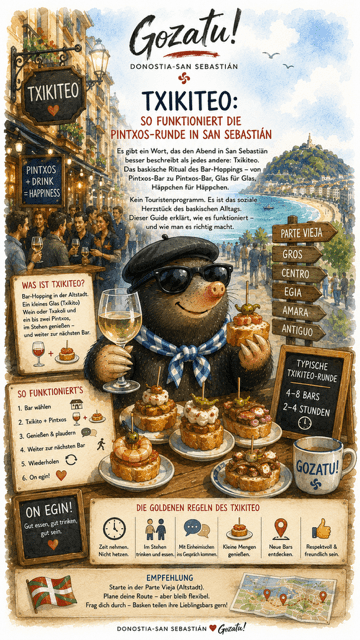
There is one word that sums up an evening in San Sebastián better than any other: txikiteo. Pronounced roughly ‘chee-kee-TAY-oh’, it describes the Basque ritual of bar-hopping – from pintxos bar to pintxos bar, glass by glass, bite by bite. Do it once and you’ll understand why Donostia-San Sebastián is regarded worldwide as a capital of gastronomy.
Txikiteo is not a tourist programme. It is the social heart of everyday Basque life. Families, groups of friends, elderly gentlemen, young couples – everyone does it. This guide explains how it works and how to do it properly.
➡️ New to txikiteo? The concept, its history and the unwritten rules are explained in the txikiteo culture guide: history & rules (in German). This page is about the actual route. More bars for a round of your own are listed in the overview of all pintxos bars by neighbourhood (in German). For a different day or time, the pintxos planner (in German) puts together a round just for you.
What is txikiteo?
Txikiteo – also called poteo in Castilian, or chiquiteo – means wandering from bar to bar in the old town. You walk into a bar, order a small glass (txikito) of wine or txakoli and one or two pintxos, eat and drink standing up, and move on.
A full round takes in four to eight bars and lasts two to four hours. By the end you’re neither drunk nor stuffed – the Basques say On egin! to wish each other a good meal, and that is exactly the feeling you’re after.
The rules – unwritten, but clear
- No more than 2–3 pintxos per bar – order more and you’ll be done after the second bar.
- Standing is normal – tables are for restaurants. Pintxos are eaten at the counter.
- Don’t say ‘tapas’ – in the Basque Country they’re called pintxos. Always.
- The counter shows the cold pintxos – the best ones come from the kitchen. Always ask about the chalkboard.
- You pay at the end – the bartender keeps count.
- Many bars are closed on Mondays – Thursday to Sunday is the best time.
What to say at the counter – from ‘Kaixo’ to ‘Kontua, mesedez’ – is in the “At the counter” cheat sheet (in German). Its tally sheet lets you keep track of what you’ve had, and at the end it gives you the right phrase for paying.
What to drink: txakoli, sidra and more
The classic txikiteo drink is txakoli – the Basque white wine produced under three designations of origin (DO): Getariako Txakolina (the best known, around Getaria), Bizkaiko Txakolina and Arabako Txakolina. Light, lively, 10–11% ABV. Txakoli is traditionally poured into the glass from a great height – this opens up the aroma and brings out the fine natural sparkle.
The alternative: sidra (Basque cider), also poured from a height with the characteristic escanciado flourish. Or a small glass of Rioja. Beer is possible, but it’s not a classic txikiteo drink.
The best route: Parte Vieja
The centre of txikiteo is the Parte Vieja (in German) – Donostia’s old town. Between Plaza de la Constitución, Calle 31 de Agosto, Calle Fermin Calbeton and the harbour, dozens of pintxos bars are packed into a tiny area.
A classic route for first-timers:
- Ganbara (in German) – mushrooms and seafood, the counter as a work of art
- Casa Urola (in German) – Michelin level, standing up
- La Viña (in German) – Basque burnt cheesecake as a sweet finale
For a second evening: a txikiteo round through Gros (in German) – fewer tourists, more modern cooking. Bar Bergara (in German) is the must-visit address.
Txikiteo vs tapas: the difference
If you know southern Spain, your first thought is: rather like tapas. The difference is in the detail. In some regions of Spain, tapas come as a little extra with your drink, often at the table. Pintxos are always paid for, sit on the counter and are eaten standing up. Above all, though: with txikiteo you go out for the round itself – not for one particular bar. The wandering is the whole point.
When is the best time?
In the evening between 19:00 and 22:00. The Parte Vieja is at its liveliest from Thursday to Saturday, especially from 20:00. At lunchtime, between 12:00 and 15:00, there are fresh pintxos too, and less of a crush.
Txikiteo FAQ
What is txikiteo?
Txikiteo is the Basque ritual of bar-hopping: from pintxos bar to pintxos bar, glass by glass, bite by bite. Two to four hours, four to eight bars – the social heart of a Basque evening.
How many bars do you visit on a txikiteo?
Typically four to eight bars. One glass and one or two pintxos per bar – keeping on the move is the principle.
What do you drink on a txikiteo?
Traditionally txakoli (DO Getariako Txakolina or Bizkaiko Txakolina) or sidra. Txakoli is poured into the glass from a great height, sidra with the escanciado flourish.
When does txikiteo happen?
In the evening from 19:00 to 22:00, best from Thursday to Saturday. Lunchtime from 12:00 to 15:00 works too, and is quieter.
You might also like
➡️ Txikiteo culture guide: history & rules (in German)
➡️ The 10 best pintxos bars in San Sebastián
➡️ Cheap pintxos in San Sebastián
➡️ San Sebastián insider tips (in German)
➡️ Donostia-San Sebastián travel guide
➡️ The ‘bote’ in the Basque Country (in German)

About the author
Christian is a wine merchant and food blogger. On Gozatu! he writes about good food and drink in Donostia-San Sebastián and the Basque Country – with passion and soul, always first-hand on the ground. More about Christian →
Leave a Reply