
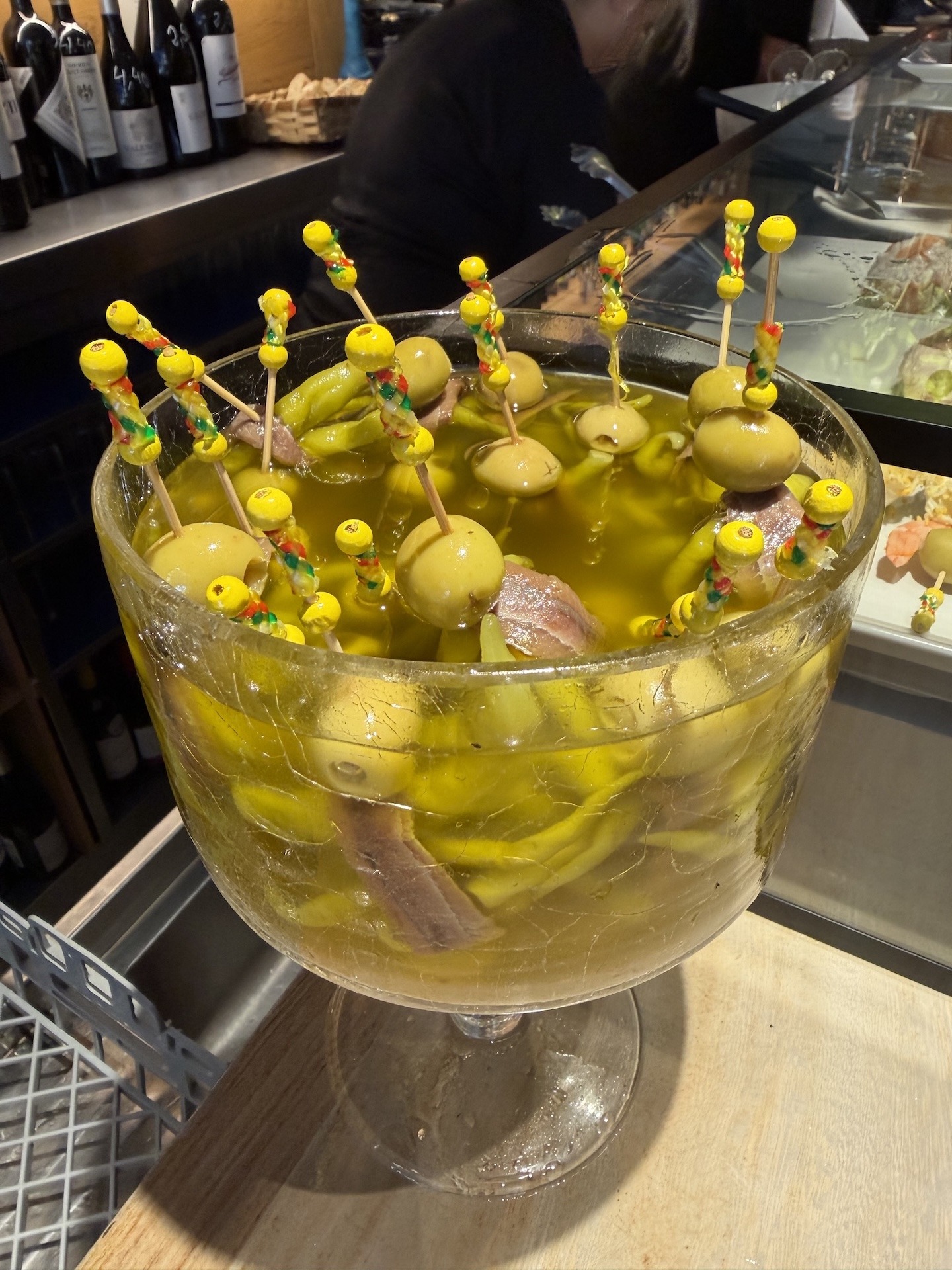
Three ingredients, one cocktail stick, no kitchen – and still the most famous pintxo in the Basque Country. In Donostia-San Sebastián, the gilda is how every evening begins, and precisely because it is so simple, it separates the wheat from the chaff: skimp on the olive, the piparra or the anchovy and there’s nowhere to hide. Here are ten places where everything comes together – all of them tried by me. If you want to make a gilda at home, you’ll find the recipe in the article La Gilda – the iconic pintxo.
The best gildas in San Sebastián at a glance
- Selection: 10 favourites, alphabetical – no ranking, no scores
- Neighbourhoods: Centro, Gros, Antiguo – plus Hernani
- Classic ingredients: Manzanilla olive, guindilla (piparra), anchovy, good olive oil
- Best time: the txikiteo hour from 7 pm, as the first bite of the evening
- Price level: € – the gilda is one of the cheapest pintxos in the city
- What to drink: Txakoli, vermouth or a zurito
- Based on: every place visited in person
🗺️ Location & Getting Around
Nine of the ten places are in Donostia itself. The focus is the Centro, with Bar Vallés, Ikili, La Bella Easo, Lanperna and La Taberna de Blas – mostly less than ten minutes’ walk from one another according to the map, with La Bella Easo on Plaza Easo at the southern edge. Elosta, Sua.Muka by the Kursaal and Txofre are in Gros; from the Centro it’s around ten minutes across the Zurriola or Santa Katalina bridge, again according to the map. Milla Lore 124 is in Antiguo on Tolosa Hiribidea. Lurra Café at Chillida Leku is outside the city in Hernani – you get there by bus or car.
All the places on this list are also marked on the map of Donostia-San Sebastián (in German).
A short history of the gilda
The gilda has a birthplace, and it’s in this city: Bar Vallés (in German), officially Casa Vallés, founded in 1942 on Calle Los Reyes Católicos. In the late 1940s, a regular there called Joaquín Aramburu – known to everyone as “Txepetxa” – threaded a pickled guindilla, a salted anchovy and a Manzanilla olive onto a cocktail stick. No recipe, no concept, just the wish for something salty to go with the wine.
The bite needed a name. Rita Hayworth happened to be on in Spanish cinemas in Charles Vidor’s 1946 film “Gilda” – a film that caused quite a stir in Franco’s Spain. The skewer was described in the same words as the film character: verde, salada y un poco picante – green, salty and a little bit spicy. The name stuck, and it has stayed to this day.
That makes the gilda more than a snack: it is regarded as the very first pintxo to be conceived as one – not as leftovers, not as a side, but as a small bite in its own right to go with a drink. Everything you see on the counters of the Parte Vieja (Old Town) today is essentially its offspring.
The ingredients – and why they make all the difference
The guindilla in the Basque Country is almost always a piparra, usually from Ibarra near Tolosa. It is picked young, pickled in vinegar and isn’t really hot, but grassy and tangy with a fine bite. Reach for any old chilli instead and you lose exactly that green freshness.
The anchovy is the most expensive part. A salt-cured anchoa from the Cantabrian Sea – from Getaria, Ondarroa or Santoña – has depth, umami and a firm texture. The alternative is the boquerón, marinated in vinegar, white and distinctly more acidic. Both are legitimate, but they make two completely different gildas.
The olive is traditionally a Manzanilla, pitted or not – and that is precisely where there’s a little trap you should know about. The oil, finally, isn’t there for decoration: a dash of good olive oil ties salt, acidity and heat together. Without it, the gilda falls apart into three separate pieces.
Variations: from purist to fusion
The basic principle is so simple that it invites variation. The most common departure is swapping the salted anchovy for a boquerón – zestier, sharper, with a longer finish. Then there are versions with bonito or red tuna instead of anchovy, stuffed olives, extra silverskin onions, anchovy butter or a second piparra for more bite.
And then there are the kitchens that take the gilda apart and put it back together: as a tartare, as a sauce, as a garnish in vermouth or a martini. Elosta (in German) has one such version on the menu – red tuna, piparras, fried onions, anchovy and olive sauce. All it shares with the original gilda is the basic motif, and it still works brilliantly.
How it spread: from a bar in Donostia to the whole world
From Reyes Católicos, the gilda spread first across Gipuzkoa, then throughout the Basque Country and Navarre. Today it’s on menus all over Spain, and it has long since crossed the border – into tapas bars in Berlin, London or New York, often under the name “Basque skewer” or simply as a gilda.
In Donostia it’s part of the standard repertoire of practically every bar. That’s exactly why it’s a good yardstick: it costs next to nothing, no technique can rescue it, and you can taste straight away if someone has skimped on the ingredients. If the gilda is right, the rest of the counter usually is too.
A few anecdotes
The film that gave the gilda its name was anything but uncontroversial in Spain: Rita Hayworth’s glove routine provoked protests from the Church and cuts by the censors – and that, of all things, became the name of a pintxo every child knows today.
The order on the skewer, incidentally, is a matter of faith that people here can happily argue about: olive first, piparra folded in the middle, anchovy wrapped around it – or all of it the other way round. And for a long time the cocktail stick was more than cutlery: in the old bars, they simply counted the sticks on the plate at the end of the evening, and that was the bill. It was a point of honour that nobody cheated.
My 10 favourite gildas in Donostia-San Sebastián
In alphabetical order – no ranking. (Linked reviews are in German.)
Bar Vallés · Centro
The classic, the inventor, the original gilda. This is where it was first put together in the late 1940s, and this is where you can still get it today – although nowadays with plenty of visitors from out of town, too. That doesn’t diminish it: if you want to understand what this pintxo is all about, start here. A tip from my own experience: watch out for the olive stone.

📍 Bar Vallés (Casa Vallés), Calle Los Reyes Católicos 10, 20006 Donostia-San Sebastián · +34 943 45 22 10
Elosta · Gros
The fusion gilda. “La Gilda del Elosta” is made of red tuna, piparras, fried onions and an anchovy and olive sauce – daring, exciting, ravishingly good. That a place known for purist sushi, of all things, takes the Basque classic apart with such assurance makes it all the more delightful. A must-taste.

📍 Elosta, San Frantzisko Kalea 26, 20002 Donostia-San Sebastián · +34 843 63 03 25
Ikili · Centro
The unfussy one. Always a match. At Ikili they know exactly what produce they’re working with – and that goes for the tortilla and the gilda alike. No effects, no interpretation, just three first-class ingredients in the right order. That’s exactly why you keep ending up here.

📍 Ikili Jatetxea & Bar, San Martzial Kalea 7, 20005 Donostia-San Sebastián · +34 843 93 30 00
La Bella Easo · Centro
The fresh one. In this neighbourhood bar on Plaza Easo, steeped in tradition, the gilda is assembled à la minute – only once you order. And you can taste it: rustic, honest and unbelievably good. At €2.30 (as of October 2026), it’s one of the best bites in the neighbourhood, and here a glass of house Txakoli belongs with it.

📍 La Bella Easo, Easo Enparantza 7, 20006 Donostia-San Sebastián · +34 943 46 76 12
Lanperna · Centro
The refined and balanced one, served in the elegant setting of a place that otherwise devotes itself to percebes (goose barnacles) and Atlantic fish. Salt, spice, bite and green fruit stand side by side here in perfect alliance – nothing pushes to the fore. If you’d like to try a gilda in calm surroundings for once rather than in a crowd, this is the place.

📍 Lanperna Jatetxea, San Martzial Kalea 50, 20005 Donostia-San Sebastián · +34 943 42 75 77
La Taberna de Blas · Centro
An unfussy neighbourhood spot with one of the best gildas in the city. Here all the components fit together perfectly – and the locals appreciate it. A few steps from La Concha but without the bustle of the Old Town: upstairs the bar with its terrace, downstairs the cellar restaurant. Note that the gilda is a lunchtime pleasure here – they close in the afternoon.

📍 La Taberna de Blas, San Martin Kalea 56, 20007 Donostia-San Sebastián · +34 943 46 13 21
Lurra Café at Chillida Leku · Hernani
Not in Donostia-San Sebastián, but worth the trip – and not only for the museum. At Lurra Café, right in the middle of the sculpture park, the finest hand-picked ingredients are turned into little masterpieces – and the gilda is most definitely one of them. Chillida would have been delighted with these bites.

📍 Lurra Café, Chillida Leku, Jauregi Bailara 66A, 20120 Hernani · +34 689 55 72 05
Milla Lore 124 · Antiguo
The perfect one. Brought to the table by masterly hands, by graduates of the Basque Culinary Center. Balanced, slightly piquant, refreshingly salty – the gilda you can measure others by. It’s a little off the usual routes in Antiguo, and worth a detour for exactly that reason.

📍 Milla Lore 124, Tolosa Hiribidea 79, 20018 Donostia-San Sebastián · +34 943 21 85 03
Sua.Muka · Gros
Although Andoni Luis Aduriz is better known for the innovative cooking at his Mugaritz, in his other projects he manages to show off the classics of the local cuisine to perfection. At Sua.Muka by the Kursaal, that is exactly what happens with the gilda: a rush of flavour, just as it should be. A must-have.

📍 Sua.Muka, Zurriola Hiribidea 1 (Kursaal), 20002 Donostia-San Sebastián · +34 943 00 31 62
Txofre · Gros
Txofre is all about quality and Basque culture – and the gilda proves it. Unpretentious, relaxed, delicious, effortlessly tossed off. Always hits the spot. An old-school pub in Gros where the locals sit and nobody makes a fuss about anything.

📍 Txofre Taberna, Gloria Kalea 2a, 20001 Donostia-San Sebastián · +34 943 27 13 74
🗣️ My Impressions
The gilda is the most honest pintxo there is. There’s no technique in it to hide behind – just good buying and care. Use a cheap chilli, a tired anchovy and an olive from a catering tub, and people will taste it in the first bite. And the reverse: a good piparra from Ibarra with a proper anchoa from the Cantabrian Sea, plus a dash of decent oil – that’s all it takes.
That’s why it’s the first thing I order almost everywhere. It costs next to nothing and tells me more about a bar than half the menu. These ten places have passed exactly that test – from the origins at Bar Vallés and the perfectly balanced version at Milla Lore to the fusion at Elosta, which respectfully turns the classic on its head. Turning that into a ranking would be too simple for me.
ℹ️ About this selection
This list is a personal selection – not a ranking and not a critique. The ten places stand side by side in alphabetical order; there is no first place and no last. I’m not a restaurant critic but a wine merchant and food blogger: I only write about places that have won me over.
I do my best to try a lot – but with around 1,400 places in Donostia, nobody can know them all. That’s why this list is continually expanded and updated. As of 8 October 2026.
📋 Practical tips for your gilda tour
- Mind the stone: Not every olive is pitted – at Bar Vallés, for example. Test it carefully first, then bite in heartily.
- Order it first: The gilda is the classic opener. Salt and acidity whet your appetite for everything that follows.
- Anchoa or boquerón? Salted anchoa means depth and umami, boquerón means acidity and sharpness. It’s best to try both takes and find your own favourite.
- Freshly skewered: At La Bella Easo on Plaza Easo, the gilda is assembled à la minute – only once you order.
- What to drink: Txakoli is the obvious choice, a vermouth the traditional one. Red wine hardly works with this much salt.
- Doable on foot: Centro and Gros are close together. Milla Lore in Antiguo and Lurra Café in Hernani each need a separate trip – and both are worth it.
- Daytime places: La Taberna de Blas and Lurra Café close in the afternoon. Both belong in your plans for the day, not in the evening round.
- Check closing days: Almost all the places have a fixed closing day. You’ll find the current hours in each linked review.
- Gilda Eguna: Once a year, on a Saturday in December, Gipuzkoa celebrates its most famous pintxo. More than 100 bars in around 20 towns then serve the gilda all day for €1. In 2026 it’s Saturday 19 December. Shortly beforehand, you’ll find the participating bars on gilda.eus.
Beyond these ten, I recommend the gilda at many other bars, both in the city and in the rest of the Basque Country. You’ll find them all in the dish directory with all the gilda places (in German).
More recommendations in San Sebastián
Txikiteo (in German) – the Basque ritual of bar-hopping, complete with its unwritten rules.
Bar Vallés (in German) – the place where the gilda was created, in a detailed portrait.
Donostia-San Sebastián – the big overview: neighbourhoods, food, drink and getting your bearings.
Txakoli – the Basque white wine that goes with the gilda: origin, style and the most important wineries.
Eating and drinking in Donostia (in German) – the complete guide: pintxos, restaurants, markets and the rules at the bar.
More best-of lists from Donostia-San Sebastián
The 10 best txuletas in San Sebastián (in German) – the Basque rib steak from mature beef, ten places in the city.
The 10 best pintxos bars in San Sebastián – the city’s classics, counter by counter.
Cheap pintxos in San Sebastián (in German) – eating well without the tourist mark-up, with prices and pintxo-pote.
The best tortilla in San Sebastián (in German) – where the potato tortilla is still runny in the middle.
The 10 best tomato salads in San Sebastián (in German) – in high summer, the best dish in the city.
The 10 best croquetas in San Sebastián (in German) – crisp outside, creamy inside: the best croquetas.
The 10 best Basque cheesecakes in San Sebastián – the Basque tarta de queso, from the legend to the insider tip.
The 10 best restaurants in San Sebastián (in German) – from Michelin-starred cuisine to classics with tradition.
The 10 best fish restaurants in San Sebastián (in German) – fish and seafood, from the grill to the counter.
The 10 best breakfast cafés in San Sebastián – where the day starts with good coffee and fresh pastries.
The 10 best things to see in San Sebastián – La Concha, Monte Urgull, Kursaal: the city’s highlights.
10 sports activities in and around San Sebastián (in German) – surfing, kayaking, paragliding and more, each with a provider.
10 indoor activities for bad weather in San Sebastián – ideas for rainy days, from the aquarium to the climbing hall.
The 10 best day trips from San Sebastián – destinations in the Basque Country you can do in a day.
All best-of lists at a glance → (in German)
🎮 Fancy a round? In the game Build the Gilda! (in German) you catch the cocktail stick, olive, anchoa and piparra – in exactly the order called at the counter.
Frequently asked questions about the gilda
What is a gilda?
A gilda is a pintxo from the Basque Country: a green olive, a pickled guindilla or piparra pepper and an anchovy, skewered on a cocktail stick and drizzled with a little olive oil. It is regarded as the very first pintxo and is served in practically every bar in Donostia-San Sebastián. You’ll find its origins, its flavour and the recipe to make it yourself in the article La Gilda – the iconic pintxo from San Sebastián.
Where was the gilda invented?
At Bar Vallés (in German), officially Casa Vallés, on Calle Los Reyes Católicos in the Centro of Donostia-San Sebastián. It was there in the late 1940s that the regular Joaquín Aramburu, known as “Txepetxa”, first combined guindilla, salted anchovy and olive on a cocktail stick.
Where does the name gilda come from?
From the 1946 film “Gilda” starring Rita Hayworth, which was shown in Spain shortly afterwards. The skewer was described in the same words as the film character: green, salty and a little bit spicy – verde, salada y un poco picante.
Which ingredients belong in a real gilda?
Traditionally: a Manzanilla olive, a piparra pickled in vinegar – ideally from Ibarra near Tolosa – and a salt-cured anchoa from the Cantabrian Sea, plus a dash of good olive oil. Common variations replace the salted anchovy with a boquerón or use bonito instead of anchovy.
Is the gilda an expensive pintxo?
No, it’s one of the cheapest pintxos in the city and at the same time one of the best yardsticks for the quality of a bar’s produce. Prices vary from bar to bar; for an overview, see the article Eating pintxos on a budget (in German).
Is there a gilda day?
Yes, Gilda Eguna. It takes place every year on a Saturday in December – in 2026, on 19 December. More than 100 bars in Gipuzkoa, including in San Sebastián, then sell the gilda all day for €1.

About the author
Christian is a wine merchant and food blogger. On Gozatu! he writes about good food and drink in Donostia-San Sebastián and the Basque Country – with passion and soul, always first-hand on the ground. More about Christian →
Leave a Reply